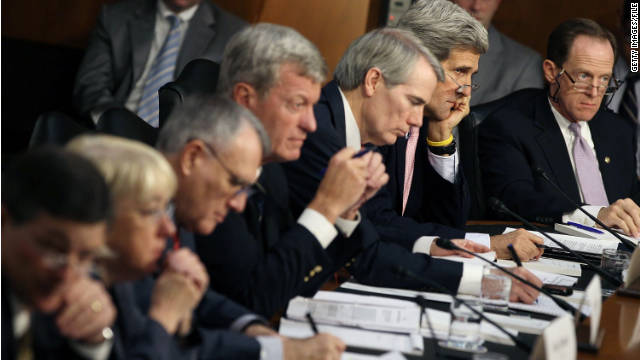

- Republicans reject latest proposal from Democrats
- Impasse over taxes, entitlements continues
- The super committee has a week left to find at least $1.2 trillion in savings
Washington (CNN) -- A week before their deadline, Democrats and Republicans on a special joint deficit committee blamed each other for a failure to compromise on how to reform the tax code and entitlement programs such as Medicare and Social Security.
House Speaker John Boehner's spokesman panned the latest Democratic proposal as "a step backward," while Democrats complained their offer to agree to a lower Republican figure for increased tax revenue was met with further stonewalling.
The 12-member special joint congressional committee created as part of the debt ceiling agreement earlier this year has until November 23 to come up with a plan for at least $1.2 trillion in deficit reduction steps.
Democrats call for a balanced approach that includes increased tax revenue, spending cuts and entitlement reforms, while Republicans seeking smaller government want most of the package to be spending cuts and entitlement reforms.
According to several Democratic aides involved in the talks, Democrats lowered their figure for increased revenue in the package from $1 trillion to $400 billion to match a standing GOP proposal put forward by Sen. Pat Toomey, R-Pennsylvania, a member of the deficit committee.

 Clock ticking on super committee
  Deficit cutting deadline near
  Gingrich blasts super committee
  Explain it to me: The 'Super Committee'
 The Toomey plan included about $250 billion in new tax increases, while the Democratic plan would have all $400 billion in increased revenue come from new taxes through limited tax deductions and closed loopholes, the Democratic aides said.
Also, the Toomey plan called for lowering tax rates across-the-board as part of broader tax reform, but Democrats did not include that in their plan.
In exchange for meeting the GOP revenue figure, Democrats also sought to limit changes to entitlements depended on by senior citizens, the disabled and the poor.
Democratic Sen. Patty Murray of Washington, the committee co-chair, presented the plan last Friday to the Republican co-chair, Rep. Jeb Hensarling of Texas.
Wednesday's comments showed a breakthrough remained well out of reach.
"It was so outlandish," one Republican aide close to the negotiation said of the Democratic proposal. "It was worse than their original package. So it wasn't like it was a compromise."
A Democratic aide insisted his side was not issuing an ultimatum, adding: "What we're saying is they've drawn a lot of lines in the sand and we're trying to meet them there."
The Democratic plan also would accept Toomey's proposal to reduce spending by more than $800 billion, bringing the total deficit reduction figure over 10 years to the minimum target of $1.2 trillion required by legislation that created the panel.
In return for accepting the GOP figures, Democrats said they would not accept Republican demands to raise the Medicare eligibility age to 67, lower cost-of-living increases for Social Security beneficiaries, and permanently reduce all income tax rates.
The Democratic package would also include spending of about $700 billion on measures that Democrats believe are needed to jump-start the economy: an extension of the payroll tax cut and continued benefits for people who have been unemployed for an extended period.
It also would include money to permanently prevent cuts in payments to doctors who treat Medicare patients. Democrats want to offset those costs with the money saved from winding down the wars in Iraq and Afghanistan, a step that some legislators in both parties have criticized as an accounting gimmick.
Boehner's spokesman, Michael Steel, said failing to lower the tax rates as sought by Republicans would mean a huge increase when Bush-era tax cuts expire at the end of 2012.
Hensarling told CNBC Tuesday night that Republicans "have gone as far as we feel we can go" in terms of agreeing to new tax revenues. He softened that stance Wednesday, saying he was willing to look at any new offer.
At least seven of the panel's 12 members, evenly split between Democrats and Republicans in the House and Senate, need to agree on savings of at least $1.2 trillion over the next 10 years. If they can do so, Congress will have one month -- until December 23 -- to vote on the deal.
A failure to pass any agreement would result in $1.2 trillion in automatic across-the-board spending cuts starting in 2013, evenly divided between defense and non-defense spending. Defense Secretary Leon Panetta warned Congress this week that such cuts could cripple the American military establishment.
While Democrats have expressed concern about deep cuts in social spending, programs such as Social Security, Medicaid, food stamps and veterans' benefits would be spared the budget ax.
Despite the apparent unpopularity of the automatic cuts, it is unclear whether Congress will be able to find enough middle ground to cobble together an alternative package of savings. Congressional leaders are now weighing in on the process; Boehner, R-Ohio, and Senate Majority Leader Harry Reid, D-Nevada, met behind closed doors Tuesday.
A bipartisan group of congressmen and senators, meanwhile, held a news conference Wednesday morning urging the members of the super committee to "go big" and find a solution that far exceeds the committee's minimum $1.2 trillion goal.
"We must work across the aisle in both houses (of Congress) to get this country on the right track," said Rep. Steny Hoyer of Maryland, the No. 2 Democrat in the House of Representatives. "We have the greatest chance that we've had in a generation to strike a bold agreement."
"The right thing to do is to go big," said Sen. Saxby Chambliss, R-Georgia. "Super committee, we've got your back."
"It's time to go bold. ... It's time to get our nation's fiscal house in order," declared Rep. Jeff Fortenberry, R-Nebraska.
Dick Durbin of Illinois, the Senate's No. 2 Democrat, argued that a more ambitious package that tackles politically sensitive issues such as tax hikes and entitlement reforms might ultimately be easier for the harshly polarized Congress to pass.
"If we stand together and lock arms together, we can achieve something as a group that no individual can achieve," Durbin said. "This is our chance to step up and make a difference."
CNN's Ted Barrett, Tom Cohen, Paul Courson, Lisa Desjardins, Xuan Thai, Kate Bolduan, Alan Silverleib and Deirdre Walsh contributed to this report.

Source: http://rss.cnn.com/~r/rss/cnn_topstories/~3/v943lJkLMZg/index.html
bbc news arabic bbc news radio bbc news online bbc news bbc middle east bbc latest news

No comments:
Post a Comment